
Please preserve the consequences elsewhere
Emergency rescues, displaced workers, and who bears the losses.
20 / The committee for the preservation of consequences
Creative destruction sounds clean in a sentence because the sentence does not have to relocate. A worker does. So does a family whose income depends on a threatened employer. A small supplier may have bought equipment for a customer that now cancels orders. A town may have made plans around a project that does not proceed. These are not objections to all change. They are reasons to stop describing adjustment as though only a spreadsheet experiences it. Displacement is part of the historical argument, not an accounting error.1
The case for renewal and the case for helping people through renewal are not inherently opposed. A society can allow unproductive firms to fail while supporting workers, preserving essential services, or making it easier to move into new opportunities. It can also design support badly, entrench incumbents, or postpone necessary changes. The argument belongs at the level of mechanisms and beneficiaries, not slogans.
Suppose a failed company owns useful machinery and employs skilled people. One response is to preserve the existing financial claims exactly as they were. Another is to restructure those claims so the useful operation can continue. A third is to transfer assets to a better operator. A fourth is to let the operation close and support people in finding other work. Which is best depends on facts. The mere existence of something worth preserving does not settle what must be preserved around it.
The SVB intervention discussed in Part V protected depositors while excluding shareholders and certain unsecured debtholders; senior management was removed.22 Whatever one thinks of that decision, its categories matter. A rescue can preserve a function without preserving every claim around it.
There is an equally unhelpful performance on the other side: treating avoidable collateral damage as proof of moral seriousness. A policy that prevents a payments breakdown is not automatically a surrender to financiers. Refusing all intervention can impose costs on people who did not choose the risk. Purity is easier when the bill goes to strangers.
The question, then, is how to preserve useful functions without turning every successful claim to importance into a permanent exemption. Accountability can include losses for owners, changes in management, restrictions on future behavior, more transparent exposure, or a different structure. These are categories of choices, not a universal prescription. The appropriate design depends on the institution and the problem.
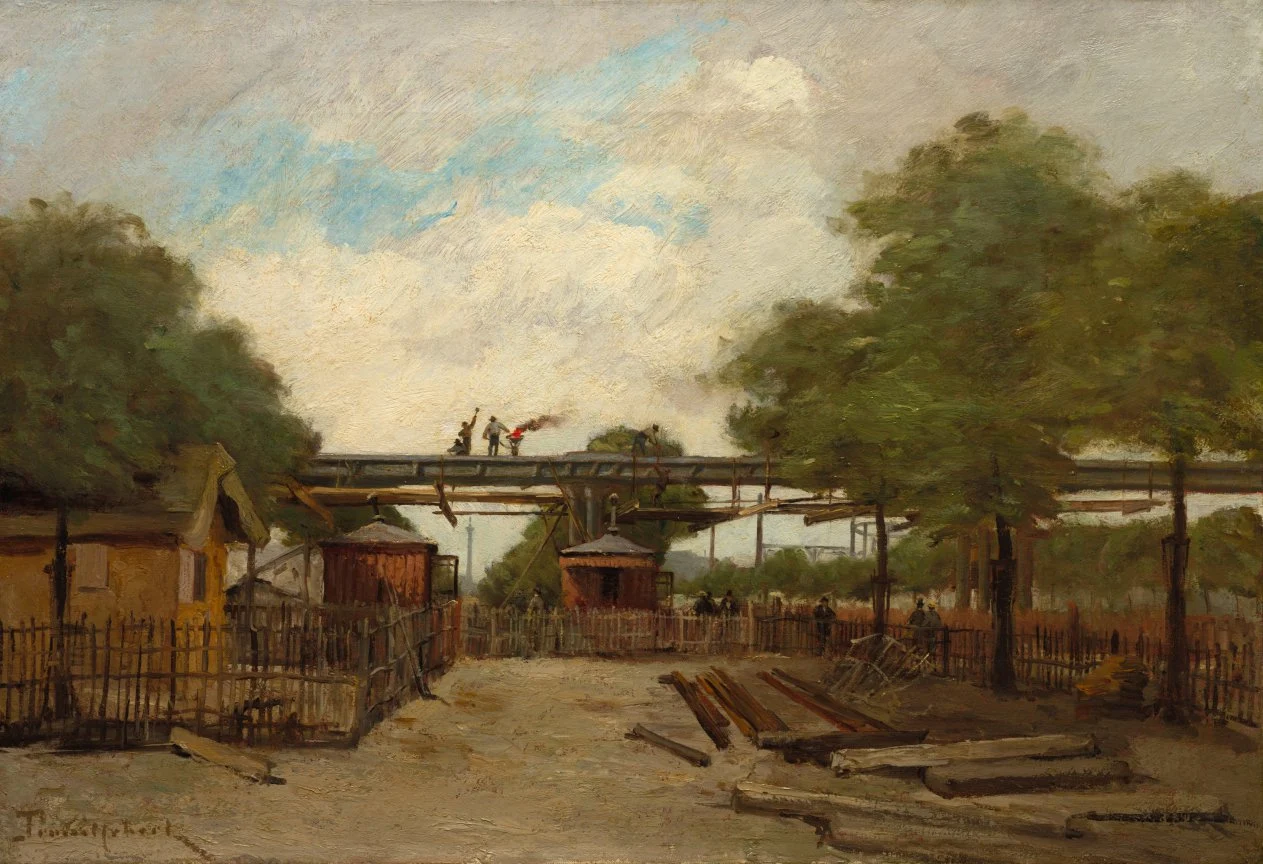
The people doing the work remain outside the boardroom. A painted construction scene, not evidence of a particular financial event.
Paul Désiré Trouillebert, Construction of an Elevated Railway: Bridge over the Cours de Vincennes, 1888. Cleveland Museum of Art · Bequest of Noah L. Butkin · CC0. Collection record ↗21 / The bear case has a business model, too
It is time to annoy the other half of the room. Predicting disaster can be a way of understanding risk. It can also be a way of occupying the most flattering position in an uncertain world: the person who sees through everyone else's illusions. This role offers intellectual prestige before the forecast has been tested. It requires no factory, no customer support, and remarkably little inventory.
A good warning becomes more useful as it becomes more specific. It names an exposure, explains a transmission channel, distinguishes evidence from inference, and says what would change the assessment. A bad warning becomes more expansive. Every development confirms it. Rising prices show mania. Falling prices show collapse. Stable prices show manipulation. Intervention proves the system was broken; the absence of intervention proves nobody understands the danger.
There may be valid arguments about intervention or distorted prices in a particular case. The problem is not any one explanation. It is the combination that makes the conclusion impossible to revise. A framework that predicts every possible observation has difficulty telling us which observation to expect.
The standard is therefore symmetrical. A bullish claim should survive questions about cost, price, competition, and financing. A bearish claim should survive questions about adaptation, buffers, genuine productivity, and the possibility that the people involved have noticed some of the same risks. Neither side gets to use sophistication as an exemption from being specific.
22 / A due-diligence meeting with the future
The first question goes to the product team: what has actually been demonstrated? Not the most impressive example, but the repeatable result. What does the customer have to provide? Where does human review remain necessary? What happens on the difficult cases? A competent team should welcome questions that make the deployment more reliable. If every request for detail is treated as hostility to innovation, the meeting is already teaching us something.
The second question goes to the commercial team: who pays, why do they renew, and what happens at a less subsidized price? A large user count can be encouraging. It does not settle willingness to pay. A signed contract can be valuable. Its cancellation terms, counterparty strength, and implementation requirements still matter. Evidence of demand has degrees. A forecast is not a receipt wearing a future date.
The third question goes to the people building capacity: which commitments are reversible? Can investment be phased? Can equipment be redeployed? Which dependencies might delay operation? What would we do if demand were lower, power later, or technology different? Planning for alternatives is not defeatism. It is how a real project keeps moving when the world declines to behave like the rendering.
The fourth question goes to finance: how much disappointment can the structure tolerate? The answer should separate operating costs, debt service, replacement needs, and other cash demands. It should describe maturities, collateral requirements, and access to funding under stress. “We have strong partners” may be reassuring, but the relevant question is which obligations those partners have actually accepted.
The fifth question goes to everyone: what would cause us to reduce the commitment? If the answer is nothing short of total failure, the organization may be mistaking a plan for an identity. A useful stopping rule need not be mechanical or public. It should at least exist. Otherwise each new investment becomes evidence that too much has already been invested to reconsider.
The sixth question is the least comfortable: if the project fails, who pays? Equity owners, creditors, employees, suppliers, customers, other financial institutions, or the public may bear different kinds of loss. Some allocation is specified in contracts. Some depends on what happens in a crisis. Understanding that distribution is part of evaluating the project, not an optional ethical supplement after the financial analysis is complete.
This is not a personal investment checklist or a promise that careful questions eliminate risk. It is an editorial test of a public narrative. The future can still surprise a well-run institution. But there is a difference between taking a risk one has tried to understand and using the scale of the ambition to avoid understanding it.
23 / What remains when the claims change hands
We believe in creative destruction, including the uncomfortable provision that today's winners remain eligible. Replacing a failed arrangement can preserve useful work. It can also displace people who had little say in the arrangement. Those people deserve more than a congratulatory account of the market's efficiency.
Return, finally, to our invented boardroom. The chairs are the same. The table is the same. The presentation still contains a magnificent image of the future. But the discussion has changed. The directors are no longer asking only how much of that future they can own. They are asking which obligations must be met while they wait, which assumptions they can afford to have wrong, and what the company would be worth to its customers if the current financial claims were rearranged.
The finance director closes her laptop. The meeting has run long. A fresh pot of coffee is brought in, and for a moment everyone appreciates the quiet competence of a system that has delivered exactly what was promised.
The invoice is left on the table.