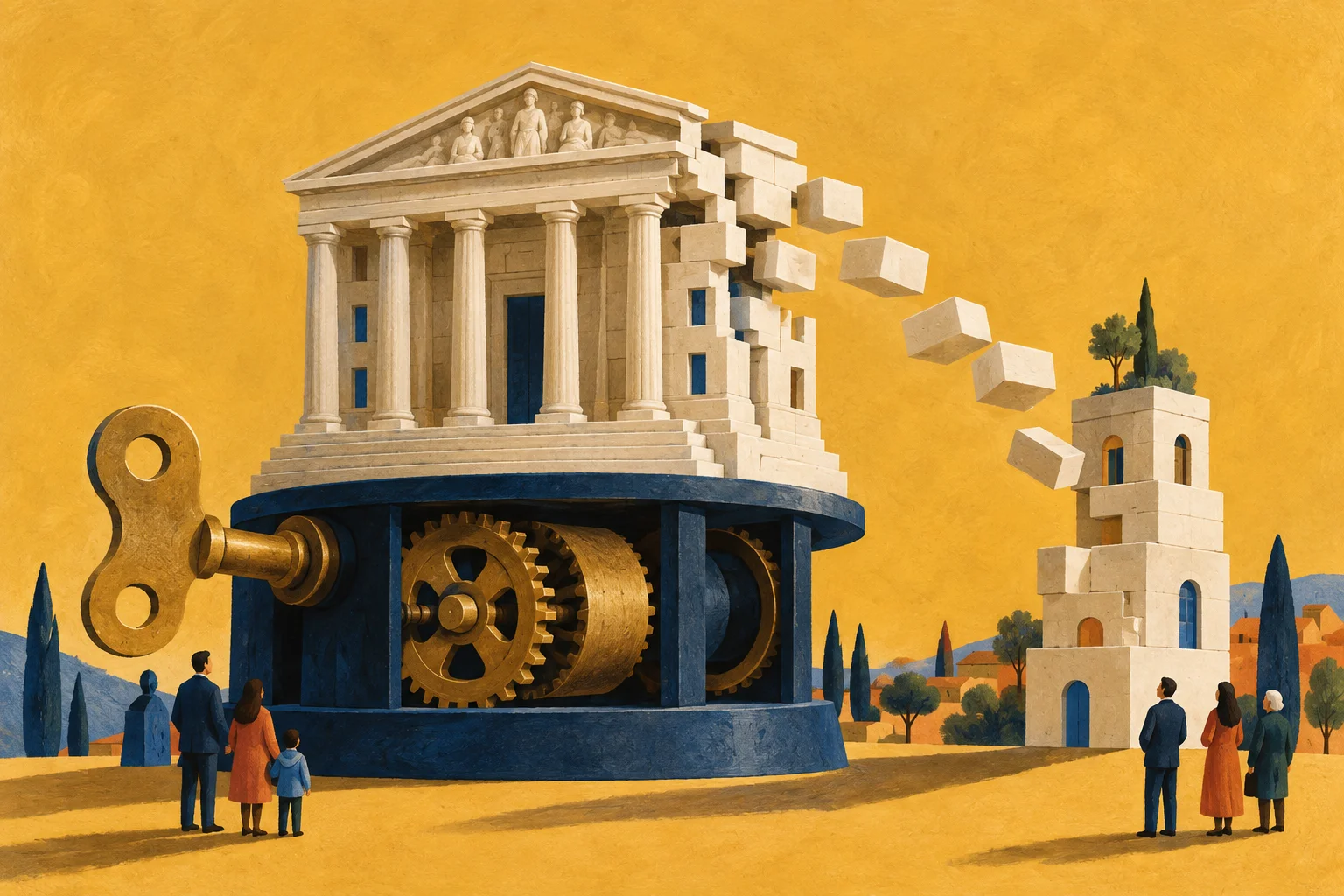
A wonderful invention. An unfortunate investment.
Progress and investment returns are different propositions.

01 / A principled commitment to other people's disruption
Imagine a boardroom in which everyone believes in creative destruction. It has been excellent for the companies down the street. Their employees have become more adaptable, their offices more available, and their difficulties a useful illustration of the market's capacity to allocate resources. Then someone advances the presentation to a slide about this company. The room's commitment to economic renewal remains absolute, although several directors now feel the transition should be managed responsibly.
This is an invented room. You may nevertheless recognize the furniture.
Two books help establish that problem. In Capitalism in America, Alan Greenspan and Adrian Wooldridge put creative destruction at the center of American economic development: productive renewal depends on shifting resources toward better uses. Their introduction also acknowledges displacement, speculative excess, and the tendency of successful challengers to become defenders of the status quo. It is a history with an argument, not a guarantee that every disruption is beneficial or that every financial claim deserves protection.1
Niall Ferguson's The Ascent of Money makes a complementary case for the historical importance of finance itself. Credit, investment institutions, and financial arrangements are part of how societies accomplish large things, not merely a parasitic commentary on those things. His accompanying 2009 lecture explores financial evolution, including institutional failure and the dangers of indefinitely preserving financial giants. The two perspectives belong in conversation; neither supplies a date for the next crash.23
There are three different claims hiding inside the sentence “this changes everything.” The technology will matter. A particular business will capture some of the value. The security being sold today will reward its purchaser at today's price. Each might be true. None makes the next one automatic. The work of a boom is often to persuade us that distinguishing them shows a disappointing lack of vision.
Admire the machine. Read the terms of the security separately.
02 / The trains were real
Start with a railroad. Not a stock certificate depicting a railroad. An actual line: grading, bridges, rails, rolling stock, stations, maintenance, workers who understand what happens when heavy things move quickly. There is a physical achievement here that no subsequent financial embarrassment can erase. A locomotive does not become less impressive because somebody financed it badly. It also does not become more solvent because it is impressive.
The Federal Reserve's historical account of the Panic of 1873 describes railroad investment running ahead of demand for new capacity. European selling of American securities worsened financing conditions. Companies could not obtain cash for operations or refinance maturing debts. Jay Cooke & Co., heavily exposed to railroads, failed in September. Loss of confidence spread beyond the original investments. This was a financing crisis around economically consequential infrastructure, not the discovery that transportation had been an elaborate hoax.4
The train keeps running after the bond fails. A new owner might buy the assets cheaply, carry less debt, and operate a respectable business on the remains of somebody else's investment. The first owner was right about the usefulness of transportation. The second owner was fortunate enough to buy after that conviction had become much less expensive.
The historical analogy has limits. A nineteenth-century railroad and an AI service have different cost structures, competitive environments, useful lives, regulations, and sources of funding. Today's largest technology companies are not interchangeable with speculative railway promoters. The point is not that the same photograph will develop again. It is that a genuine improvement in human capability does not settle the economics of every project undertaken in its name.
The train may leave the station. Your capital need not return on it.

The work between the drawing and the railway. A French construction record, not an image of the American Panic of 1873.
Édouard Baldus, Pont de l'Aran: construction progress, July 21, 1861, 1861. Cleveland Museum of Art · Gift of Michael Mattis and Judith Hochberg · CC0. Collection record ↗03 / Three clocks, one slide
To understand a technology boom, put three clocks on the wall. The first measures technical progress: how quickly the invention improves. The second measures adoption: how quickly customers can reorganize their work around it. The third measures financing: how long the company can meet its obligations before it needs more money. A good pitch deck makes the hands look synchronized. A real business has to cope when they are not.
Consider an imaginary manufacturer adopting a useful AI inspection system. The prototype spots defects. The demonstration is convincing. But the factory must integrate cameras, change procedures, teach supervisors when to override the system, document failures, and decide who signs off when machine and human disagree. The capability arrived before the institution that can use it. There is work between the demonstration and the income statement, and most of it does not wear a conference badge.
Economists Erik Brynjolfsson, Daniel Rock, and Chad Syverson describe a related mechanism in their research on the productivity J-curve: general-purpose technologies require complementary investment, including intangible organizational work. Resources go into building those complements before their benefits fully appear in measured output. It is a reason for patience about adoption, not a license to assume that every delayed return will eventually materialize.5
Suppose our manufacturer needs eighteen months to deploy the system. The vendor has nine months of cash. Its investors expect a new round in six. Its compute provider needs to be paid every month. Everyone can agree the product is useful and still end up in a highly practical argument about who is financing the twelve months that enthusiasm has omitted. The technology clock does not stop because the money clock rings.
In the imagined boardroom, the clocks are represented by a single ascending arrow. This saves space. It also saves everyone from discussing the fact that the lender owns the alarm.
Capability
When the technology can perform the task.
Adoption
When the customer can put it to work.
Financing
When the obligations must be paid.
The customer has not read your manifesto
Customers, productivity, and the incumbent asking for an exception.

04 / The customer would like a word about civilization
The strongest answer to an indiscriminate anti-AI argument is not a keynote. It is a useful result in a real workflow. Brynjolfsson, Danielle Li, and Lindsey Raymond's November 2023 working-paper version of Generative AI at Work studied 5,179 customer-support agents. It reported a 14 percent average increase in issues resolved per hour, with larger gains among less experienced workers. Those are findings from a particular deployment, not an estimate of what every worker or the entire economy will gain.6
Now introduce a second imaginary company, selling the same broad promise into a different setting. Its customers need expert judgment, privacy controls, an audit trail, and a way to catch rare but expensive errors. Producing an answer faster is useful only if the answer survives those requirements. If review absorbs the savings, the customer has acquired a very energetic assistant and an unchanged workload. If review is skipped, the savings may simply be a transfer to next quarter's incident budget.
There is another distinction here: the party that enjoys the productivity gain may not be the party selling the tool. If competition pushes software prices down, customers can capture much of the value. If a new capability makes suppliers easier to replace, profits may be competed away even as use grows. If the benefit is mostly convenience, people may love it without paying enough to support the cost of delivering it. Popularity, utility, revenue, and durable profit are related quantities, not synonyms.
Imagine a machine that makes excellent bread almost free. This would be good news for people who eat bread. It would not automatically be good news for every bakery, every oven manufacturer, every wheat supplier, and everyone who borrowed against last year's bread margins. A genuine abundance technology can make some incumbent claims less valuable. That is not a contradiction in the technology. It is the distributional consequence of it.
05 / The incumbent's difficult second act
A useful invention changes bargaining power. Someone can now do something without asking the old gatekeeper. A supplier loses an advantage. A profession loses control over a task. A customer gets an alternative. It is tempting to tell this as a morality play in which the newcomer is courageous and the incumbent is lazy. Sometimes that works. Often the incumbent is simply responsible for obligations the newcomer has not yet encountered.
A small entrant can promise a clean new system because it does not have a million customers depending on the old one. It can ignore legacy integrations because it has none. It can make individual exceptions because the founder knows every account. These are real advantages. They are not all evidence of superior character. Some are advantages of not yet being large enough to confront the problem.
The interesting transformation happens when the entrant wins. The flexible exception becomes a policy. The neglected edge case becomes a compliance incident. The customer base becomes something that must be protected from abrupt changes. The company hires people whose job is to say no. A person who once mocked procurement now has a procurement department, which is currently delaying the purchase of software from a company very much like the one he used to run.
We should be cautious about diagnosing every restriction as rent-seeking. Some restrictions prevent fraud, protect privacy, preserve reliability, or ensure that someone remains accountable. The right question is not whether the company says the word safety. It is whether the restriction addresses a demonstrable problem proportionately, and whether the company would endorse the same rule if its rival benefited from it.
The winner remains eligible for replacement. This provision attracts less enthusiasm than the part about replacing everybody else, but removing it would leave the incumbent with a fine vocabulary for defending the absence of competition.
06 / The historian is also in the photograph
There is a reason to read Greenspan with both interest and skepticism. He is not simply an external observer of financial history. In October 2008 congressional testimony, he acknowledged a failure in his expectation that financial institutions' self-interest would adequately protect shareholders. The hearing is part of the record against which his later historical arguments should be considered. It is not proof that everything he subsequently wrote is wrong, or that one official explains an entire crisis.7
One of the hardest questions in finance is why self-interest sometimes fails to produce self-preservation. Part of the answer is that there is no single self. A trader, an executive, a shareholder, a lender, a depositor, and a future taxpayer do not have identical exposures or horizons. An action can be attractive to the person making it while leaving much of the downside elsewhere. Even where interests align, information and judgment can fail. There need not be a conspiracy for the whole to behave worse than its parts expect.
Consider an invented manager rewarded for expansion, evaluated every year, and reassured that competitors are doing the same thing. Refusing the opportunity produces an immediate, visible cost to his career. Participating creates a possible, distant loss shared with many other institutions. We should not be surprised if he participates. We should be interested in why the organization built a system that makes this decision so easy.
History is useful here not because it predicts the next scene, but because it gives us better questions about the current one. Who has promised what? To whom? On which timetable? What happens if a plausible assumption turns out to be too generous? Which protections are already in place? Which are merely expected to appear?
07 / The invention and the invoice
Follow the invention out of the lab. A business has to deliver it on terms customers accept. Investors and lenders acquire claims on the cash it might produce. If those claims cannot all be honored, officials may be asked to intervene. At each step, a new party arrives with a different claim. By the end, a discussion that began with a product can have become an emergency request on behalf of civilization.
Suppose the invention works. Suppose, further, that it works so well that competition rapidly drives down the price. Customers benefit, usage expands, and the investors who financed expensive early capacity discover that they underwrote a less profitable market than expected. That is one possible disappointment. Now suppose the invention works but adoption is slower, leaving expensive infrastructure underused. That is another. Suppose adoption is fast, revenues are strong, but too much was paid for the asset. A third. None requires the invention to be fake.
In our imagined boardroom, the presentation is going well. Everyone agrees the underlying technology is extraordinary. Everyone agrees the addressable market is enormous. Everyone agrees that history rewards courage. The finance director, who has been unusually quiet, asks whether anyone would like to discuss the liabilities.
There is a brief pause. The coffee is still warm. We have reached the part of the future that has a due date.
The customers have spoken. Now follow the obligations.
Continue to Part III ↗The future has a payment schedule
Debt, liquidity, and promises that cannot all leave at once.

08 / The future has a payment schedule
The finance director has asked about liabilities. Several people take this as a comment on the vision. She is trying to find out who expects to be paid, and when. Unlike the market opportunity, these people have supplied dates.
Begin with a deliberately simple, invented project. It owns an asset worth 100. It owes 80 and has 20 of equity. Ignore interest, taxes, fees, and changes in the debt's value for a moment. If the asset rises to 110, equity rises from 20 to 30: a 50 percent gain on the original equity. If the asset falls to 90, equity falls to 10: a 50 percent loss. A relatively modest change in the asset produces a large change in the owners' residual claim. This is arithmetic, not a forecast about a real company.
Now add a lender who can demand more collateral when the asset price falls. The owner may believe, reasonably, that the asset will recover. That belief does not itself satisfy the demand for cash. If the owner must sell, the sale can push the price down further, damaging the apparent value of similar assets held elsewhere. What began as one institution's protection can help transmit pressure to others.
Equity losses alone do not establish a systemic crisis. A risky investment funded by owners prepared to lose their money can fail without preventing the rest of the economy from functioning. The question is how losses interact with obligations, leverage, liquidity, and connections. Who must act when the price changes? Who depends on that actor continuing to pay? Who owns similar assets and faces similar rules? A large number in a headline does not answer these questions.
| Position | Asset | Debt | Equity | Equity change |
|---|---|---|---|---|
| Starting point | 100 | 80 | 20 | — |
| Asset rises 10% | 110 | 80 | 30 | +50% |
| Asset falls 10% | 90 | 80 | 10 | −50% |
09 / Liquidity is not a synonym for wealth
There is a recurring disagreement in financial trouble between the person who has assets and the person who would like to be paid. The first explains what the assets are worth. The second asks whether the payment can arrive today. They may both be telling the truth. They are not discussing the same property of the balance sheet.
Solvency concerns whether assets are sufficient to cover liabilities under an appropriate valuation. Liquidity concerns the ability to meet obligations as they come due. The concepts interact, because forced sales can turn a cash problem into a loss problem. But conflating them obscures both the danger and the possible remedies. A valuable building does not make change. An excellent long-term loan cannot always be sold immediately at a fair price.
Banks make this distinction especially important. The Bank of England's explanation of modern money creation describes commercial banks creating deposits when they make loans, rather than simply passing on a fixed pile of existing savers' money. Lending remains constrained by economics, regulation, and monetary conditions. The bank acquires an asset and creates a liability; this is not permission to produce unlimited purchasing power without consequences.8
Long before online banking, Walter Bagehot examined the fragility of promises payable on demand in Lombard Street. His discussion of emergency lending emphasized lending against good security and at a high rate during a panic. It was an attempt to reconcile liquidity support with discipline, not a command to preserve every institution's owners at any price. The difficult question of distinguishing a sound borrower from an unsound one does not disappear merely because the principle is old.9
Deposit insurance and central-bank facilities exist in part to reduce destructive forms of this coordination problem. Their design matters. In the United States, the standard FDIC limit is $250,000 per depositor, per insured bank, per ownership category—not simply $250,000 for every account someone opens. Protection is a defined institutional arrangement, not a general promise that every financial product is safe.10
A bank deposit, a money-market fund share, a private-fund interest, and a stock come with different protections and exit terms. The balances can look almost identical in an app. To find out what a balance promises, leave the pleasant screen and read the documents. The worst time to discover that distinction is while trying to make a payment the screen led you to believe would be easy.
In the boardroom, somebody says the company has ample resources. The finance director agrees and asks which ones can be used on Thursday. This is received as a disappointing lack of imagination.
10 / The model has a perfectly reasonable explanation
In September 1998, fourteen financial institutions invested $3.6 billion in Long-Term Capital Management to avert a disorderly collapse. The Federal Reserve helped convene the arrangement but did not put its own funds at risk. The distinction matters: this was a privately financed rescue facilitated by public officials, not simply a taxpayer check to a hedge fund. Preventing forced liquidation was central to the intervention.11
Greenspan's October 1998 testimony about LTCM described concerns surrounding liquidation in unsettled markets and the Fed's role in facilitating the private response. Read beside the broader history, it illustrates why officials may care about the consequences of an institution's failure even when they are not trying to protect its owners. It also leaves an enduring question: how much should market participants expect such coordination to be available next time?12
Here is an invented version of the mechanism. Four firms independently discover what appears to be a small mispricing. They borrow to enlarge the return from correcting it. Each regards the position as manageable because it can be sold in an active market. Then conditions change, and all four need to reduce exposure. The market into which each planned to sell is partly composed of the other three. Their exit strategy has a customer-concentration problem.
A model gives us relationships we can inspect. Keep the assumptions beside the result: the historical period sampled, the market conditions omitted, the ways participants might react to each other. A trader selling into stress changes the environment another trader's model is trying to describe. The instrument has to cope with weather its users are helping to make.
Risk management becomes theatrical when its purpose is to make a chosen position look inevitable. It becomes useful when it can alter the position, the financing, or the decision to proceed. A report that cannot lead to a different action is often an extremely elaborate permission slip.
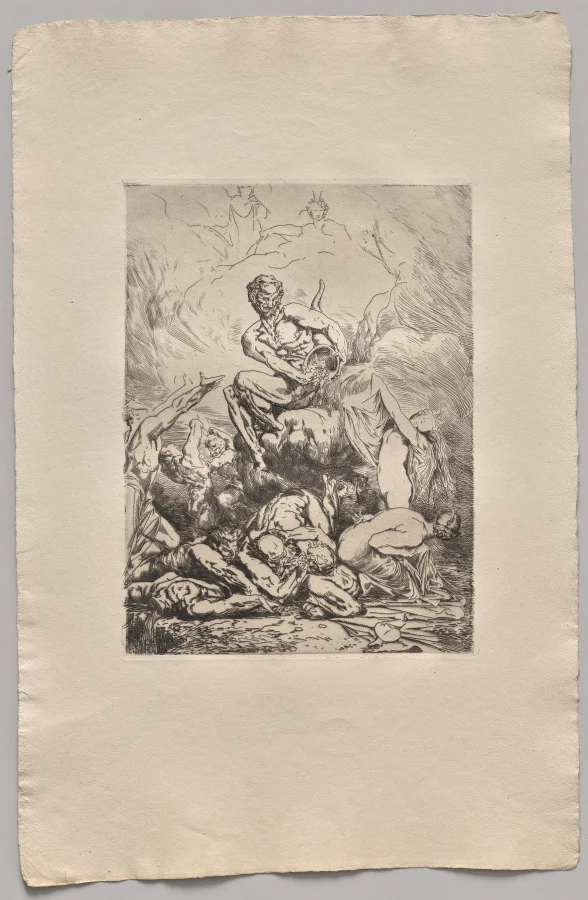
The moral drama is easier to depict than the balance sheet. Historical allegory, not a depiction of any contemporary person.
Nicolas-François Chifflart; printed by Auguste Delâtre; published by Cadart & Luquet, The Devil of Money, 1865. Cleveland Museum of Art · Carole W. and Charles B. Rosenblatt Endowment Fund · CC0. Collection record ↗11 / Private does not mean imaginary. Or liquid.
Before declaring private credit the next subprime, read which money can leave. Some vehicles lock investors' capital up for years; others offer limited periodic access. Borrowers and contracts differ too. Those details determine whether a difficult period produces waiting, selling, or a borrower unable to refinance. The category name tells us much less than the departure arrangements.
The Fed's May 2026 funding-risk discussion reported increased redemption requests at certain semi-liquid private-credit vehicles, with managers often using their permitted caps. It also said requests remained manageable and assessed the financial-stability risks from further redemptions as limited and manageable, while warning that pressure could reduce credit availability for some borrowers. A redemption limit is not itself evidence of insolvency; it can be part of the product's stated structure.13
There is a separate issue with valuation. An asset whose price is observed infrequently may appear calmer than a publicly traded asset whose price changes every second. That does not prove the underlying economic risk is lower. Nor does it prove the valuation is dishonest. It means the measurement process is different. The investor should ask how prices are established, how assumptions are tested, and how quickly deteriorating conditions would be recognized.
The IMF's April 2026 financial-stability assessment also distinguished limited liquidity mismatches in private credit from concerns about borrower stress and growing retail exposure. Its discussion was conditional: strains could test semi-liquid structures. That is a more informative claim than declaring an entire asset class doomed or invulnerable.14
Trace a financing interruption through the contracts. A borrower might lose its refinancing; a lender might draw a bank credit line; a manager might sell assets. Investors might also wait, exactly as their contract contemplated. The consequences depend on the route. Calling the market fashionable or suspect will not tell us which door the pressure goes through.
Opacity is not proof of catastrophe. It is a reason to be modest about what outsiders can confidently conclude. This applies to reassuring conclusions as much as alarming ones. If the data are incomplete, the correct response is not to choose the adjective that best matches one's preferred ending.
Everybody is financing everybody
AI financing circles, physical infrastructure, and a downside spreadsheet.

12 / The circular economy, but for conviction
A supplier invests in a customer. The customer uses some of its resources to buy the supplier's product. Another company provides infrastructure, financing, or distribution. These relationships can support real deployment. They can also make it harder to distinguish independent end demand from an ecosystem financing its own expansion. The structure alone is not evidence of fraud. It is an invitation to examine the contracts and cash flows.
A July 2026 BIS working paper models the AI investment race as competition for a small number of dominant positions. In the model, debt and circular equity links can amplify fragility and transmit losses through connected firms. These are model-based findings under specified assumptions, not a measured guarantee that actual AI companies will fail, and not an official date for a crash.15
Imagine three fictional businesses: a chip supplier, a model developer, and an application company. The supplier invests in the developer. The developer commits to infrastructure. The application company receives funding partly because it can build on the model and commits to use it. There may be excellent reasons for every step. The task is to look through the corporate boundaries and ask where money from customers outside the financing circle enters.
The analogy should not be pushed too far. Strategic customers often help fund new capacity precisely because demand is expected to be large. Long-term purchase commitments can reduce uncertainty and make investment possible. Vertical relationships can solve coordination problems. A critic who treats every partnership as suspicious has substituted a conspiracy theory for supply-chain analysis.
What would make the arrangement more convincing? Independent customer receipts. Transparent contractual obligations. Evidence that customers renew when subsidies fall. Financing that can tolerate delays. A clear account of who bears demand risk and who can walk away. None is as exciting as a diagram of interconnected logos. That is why the logos are generally larger.
In a September 10, 2026 speech, the BIS's Pablo Hernández de Cos connected ambitious AI earnings expectations with increasing use of debt and private credit, and described circular financing relationships among suppliers and AI firms. He warned about a potential reversal if returns disappoint, while explicitly saying that a bust was not inevitable. The caution is about a financing structure and an investment race, not a verdict that the technology lacks value.16
13 / A data center cannot run on a change of narrative
Some costs are unusually resistant to rhetoric. Electricity is one. Cooling is another. So are land, equipment, installation, maintenance, and the time required to connect physical infrastructure. The word cloud has performed an extraordinary public-relations service for a collection of facilities that must obey local engineering constraints.
The IEA's 2025 Energy and AI report projected that global data-center electricity consumption would roughly double to about 945 terawatt-hours by 2030 in its base case. That is a scenario projection for data centers overall, not a meter reading of AI alone and not an assured outcome. Its value for this discussion is to make the physical scale of the buildout visible.17
An imaginary infrastructure project has two schedules. The first says when the servers arrive. The second says when sufficient power becomes available. If the first runs ahead of the second, expensive equipment may wait. If the second requires commitments made before demand is certain, someone is underwriting that uncertainty. The problem may be solved through sensible contracts, phased development, or better planning. It is not solved by calling the project inevitable.
This is another way real progress can inconvenience the people financing it. Faster technical improvement benefits users while threatening the economics of existing capacity. The next model may make the service more valuable, or reduce the need for a particular kind of computation, or intensify competition. A company can be exposed to AI succeeding differently from the way its investment plan expected.
The power engineer has joined the imaginary board meeting. She has a list of constraints and an unremarkable pair of shoes. Nobody has asked her about the end of work. Several people have asked whether she can accelerate a transformer.
14 / The second spreadsheet
Let us give the finance director a second fictional example. A facility earns 30 in annual revenue and spends 18 on operating costs, leaving 12 before interest, taxes, replacement investment, and other charges. It owes 8 in annual interest. On this deliberately simplified basis, there is a cushion of 4 before those other demands. Now let revenue fall by 20 percent while operating costs stay unchanged. Revenue becomes 24, the operating surplus becomes 6, and interest still costs 8. A business that looked profitable under one assumption now cannot cover interest from that surplus.
This is not a model of an actual data center. Real contracts, variable costs, hedges, taxes, depreciation, and financing terms would change the result. The example demonstrates why a modest disappointment in revenue can produce a large change in financial flexibility when costs and obligations are relatively fixed. It also demonstrates why the original cushion should not have been casually described as free cash flow.
Now change the assumptions in a more favorable direction. Suppose costs fall with revenue, the project has more equity, or customers have creditworthy take-or-pay commitments. The stress may be manageable. Suppose the owner has other profitable operations and can fund the shortfall without jeopardizing them. The situation changes again. An analysis that omits these possibilities is not tough-minded. It is incomplete.
In the imaginary boardroom, someone asks whether the downside slide can be moved to the appendix. It makes the opportunity look complicated. The finance director explains that the opportunity is complicated. This is why she is not in charge of the narrative.
15 / What turns a disappointment into a crisis?
A failed product is not a recession. A falling stock market is not automatically a banking crisis. A credit loss is not necessarily contagious. To get from an investment disappointment to a systemic event, something must connect the original problem to the ability of other people and institutions to function. The path is more important than the adjective.
One possible path begins with returns below expectations. New financing becomes harder to obtain. Companies cut spending, suppliers lose business, and borrowers struggle to refinance. Lenders and investors become more cautious. If leverage, concentrated exposures, or forced sales amplify the pressure, losses can spread. If institutions have adequate capital, stable funding, and time to adjust, the same initial disappointment may remain contained. This is a conditional mechanism, not a forecast for a particular year.
The practical question is how many promises depend on the same favorable conditions. A company may appear diversified across several products while all its customers depend on the same funding market. A lender may have many borrowers whose revenues depend on one sector. A household may have a job, a home, and a portfolio that all benefit from the same local boom. Counting the names does not count the independent sources of resilience.
This is why a map of exposure can be more informative than a list of villains. Who owes whom? Which obligations are short-term? Which collateral values move together? Which contracts permit an early exit? Which institutions can absorb losses without reducing essential services? A system's strength is not the sum of its most confident presentations.
- Returns disappoint
- Financing tightens
- Spending and refinancing weaken
- Losses reach connected institutions
Equity cushions. Stable funding. Strong customer cash flows. Orderly restructuring. Effective liquidity support.
The crash has no calendar
Possible futures, institutional buffers, and the limits of a confident date.

16 / Please select a year for your catastrophe
A dated collapse turns uncertainty into an appointment. Ideally, it sits far enough away to permit preparation and close enough to justify the next installment. The subscriber gets a schedule. The forecaster gets time to prepare an explanation if the appointment moves.
For this essay, 2027 and 2028 are a scenario window. They are not a promise. Neither Greenspan and Wooldridge's history nor Ferguson's financial history establishes that the economy must collapse in either year. The existence of leverage does not supply a countdown. Expensive assets can become more expensive, grow into their prices, decline gradually, or fall sharply without producing a systemic breakdown. The range of outcomes is annoying but real.
A useful forecast specifies the event. Do we mean a stock-market correction, a fall in technology investment, a recession, a wave of defaults, a banking panic, or a lasting deterioration in living standards? These can interact, but they are not interchangeable. A forecaster who predicts one and later claims credit for another has improved his results by changing the exam.
It should also specify the mechanism and the observations that would make it less likely. If the argument is that financing will fail before revenues arrive, then faster revenue growth, lower costs, longer funding maturities, or greater equity support matter. If the argument is about concentrated exposure, then reduced concentration matters. If nothing can count against the forecast, we are no longer evaluating a proposition. We are being invited to join a temperament.
17 / Three possible futures, without the commemorative fleece
Let us construct three scenarios rather than select a catastrophe and work backward. They are illustrations, not assigned probabilities. Each begins with a technology that can do useful things. The differences concern how quickly those uses become sustainable revenues, how much capital has been committed, and how financial institutions absorb the gap.
In the first scenario, adoption deepens. Customers find tasks where the tools produce measurable benefits. Integration improves. Costs fall. Some firms fail, as firms do, but others earn enough to finance continued investment. Spending becomes more discriminating rather than stopping. Early valuations may still have been excessive, and investors may still lose money, yet the economy receives a productivity benefit without a systemic financial event. The future arrives looking irritatingly like operational improvement.
In the second scenario, the technology works but commercial returns arrive more slowly or accrue to different firms than expected. Investors reprice the sector. Projects are postponed. Suppliers face weaker demand. Some capital structures fail. Assets change hands. This is a serious investment bust, potentially with wider economic effects, but not automatically a banking panic. Losses are painful and uneven; they are not necessarily uncontainable.
In the third scenario, disappointing returns meet fragile financing and a second shock. Borrowers cannot refinance. Collateral values fall. Lenders or funds face pressure of their own. Forced retrenchment spreads beyond the original sector. Credit availability declines for people who had nothing to do with the most extravagant forecasts. Here, the financial structure helps transform a sectoral disappointment into a broader crisis.
What should be watched? Not a magic dashboard, but a set of connected questions: are customers renewing at workable prices; are revenues converting into cash; are financing terms becoming more demanding; are losses being recognized; are lenders extending credit; are institutions able to meet obligations without selling into pressure? One adverse reading is not a verdict. A pattern across several channels is more informative.
01 / Absorption
Adoption and cash generation support investment. Failures remain containable.
02 / Repricing
Returns disappoint. Valuations and investment fall; assets change hands.
03 / Amplification
Disappointment meets fragile funding and connected exposures. Stress spreads.
18 / The evidence that refuses to cooperate
The Fed's May 2026 Financial Stability Report, reflecting conditions and data through April 23, described elevated equity valuations and hedge-fund leverage near historical highs. It also described banks as sound and resilient overall, business and household debt vulnerabilities as moderate, and household balance sheets as strong overall. There were weaker borrowers and pockets of stress. There was not a finding that the entire system was already insolvent.18
Evidence about AI productivity also resists a clean tribal reading. METR's early-2025 experiment found that sixteen experienced open-source developers took longer on the studied tasks when AI tools were allowed. That was a result about a small group, particular tools, and familiar repositories—not a universal finding that AI reduces productivity. Its narrowness matters as much as the headline.19
In February 2026, METR explained that its follow-up experiment faced serious selection and measurement problems, including developers avoiding participation or withholding tasks they preferred to do with AI. The researchers believed speedups had likely improved but said the data were a weak basis for estimating their size. A responsible reader cannot freeze the earlier result into a permanent verdict or promote the later, biased estimate into definitive proof of acceleration.20
Separate the projects. One may have paying customers and years of funding; another may have an expensive commitment and a forecast. Assigning both the same fate because they use the same technology discards the information most likely to matter when conditions change.
19 / A weekend in which everyone discovers public infrastructure
Silicon Valley Bank is a useful case because it is close enough to the technology world to tempt lazy moralizing and specific enough to resist it. In its April 2023 review, the Fed identified failures by the bank's management and board, a concentrated business model, reliance on uninsured deposits, and shortcomings in supervision. Rising rates and slowing technology-sector activity exposed those vulnerabilities. The report also described failed internal liquidity tests and inadequate plans for obtaining liquidity under stress.21
On March 12, 2023, Treasury, the Federal Reserve, and the FDIC announced protection for all depositors at SVB and Signature Bank. The statement explicitly excluded shareholders and certain unsecured debtholders from protection, said senior management had been removed, and provided for losses to the Deposit Insurance Fund associated with uninsured-depositor protection to be recovered through a special assessment on banks. Calling the arrangement simply a rescue of bank shareholders would be false.22
A payroll clerk is not responsible for vindicating a venture capitalist's philosophy of government. Keeping her employer's payments working and keeping every investor's worldview comfortable are different public priorities. The remarkable part is how quickly an institution can move from being an obstacle to private commerce to being the only thing anyone believes can save it.
Imagine a founder who has spent the morning explaining that institutions are obsolete and the afternoon trying to discover which institution can ensure his company pays its staff. This is a fictional composite, not an account of any named person's behavior. The contradiction is recognizable because our confidence in self-sufficiency is often strongest when the supporting systems are working quietly.
A payment system can keep operating while shareholders lose their equity. A business can continue under new ownership; a service can move to another provider. Each route has practical difficulties. Each also makes “save the institution” an incomplete request. The person using the phrase should identify which parts they mean to save, especially if they own one of them.
Please preserve the consequences elsewhere
Emergency rescues, displaced workers, and who bears the losses.

20 / The committee for the preservation of consequences
Creative destruction sounds clean in a sentence because the sentence does not have to relocate. A worker does. So does a family whose income depends on a threatened employer. A small supplier may have bought equipment for a customer that now cancels orders. A town may have made plans around a project that does not proceed. These are not objections to all change. They are reasons to stop describing adjustment as though only a spreadsheet experiences it. Displacement is part of the historical argument, not an accounting error.1
The case for renewal and the case for helping people through renewal are not inherently opposed. A society can allow unproductive firms to fail while supporting workers, preserving essential services, or making it easier to move into new opportunities. It can also design support badly, entrench incumbents, or postpone necessary changes. The argument belongs at the level of mechanisms and beneficiaries, not slogans.
Suppose a failed company owns useful machinery and employs skilled people. One response is to preserve the existing financial claims exactly as they were. Another is to restructure those claims so the useful operation can continue. A third is to transfer assets to a better operator. A fourth is to let the operation close and support people in finding other work. Which is best depends on facts. The mere existence of something worth preserving does not settle what must be preserved around it.
The SVB intervention discussed in Part V protected depositors while excluding shareholders and certain unsecured debtholders; senior management was removed.22 Whatever one thinks of that decision, its categories matter. A rescue can preserve a function without preserving every claim around it.
There is an equally unhelpful performance on the other side: treating avoidable collateral damage as proof of moral seriousness. A policy that prevents a payments breakdown is not automatically a surrender to financiers. Refusing all intervention can impose costs on people who did not choose the risk. Purity is easier when the bill goes to strangers.
The question, then, is how to preserve useful functions without turning every successful claim to importance into a permanent exemption. Accountability can include losses for owners, changes in management, restrictions on future behavior, more transparent exposure, or a different structure. These are categories of choices, not a universal prescription. The appropriate design depends on the institution and the problem.

The people doing the work remain outside the boardroom. A painted construction scene, not evidence of a particular financial event.
Paul Désiré Trouillebert, Construction of an Elevated Railway: Bridge over the Cours de Vincennes, 1888. Cleveland Museum of Art · Bequest of Noah L. Butkin · CC0. Collection record ↗21 / The bear case has a business model, too
It is time to annoy the other half of the room. Predicting disaster can be a way of understanding risk. It can also be a way of occupying the most flattering position in an uncertain world: the person who sees through everyone else's illusions. This role offers intellectual prestige before the forecast has been tested. It requires no factory, no customer support, and remarkably little inventory.
A good warning becomes more useful as it becomes more specific. It names an exposure, explains a transmission channel, distinguishes evidence from inference, and says what would change the assessment. A bad warning becomes more expansive. Every development confirms it. Rising prices show mania. Falling prices show collapse. Stable prices show manipulation. Intervention proves the system was broken; the absence of intervention proves nobody understands the danger.
There may be valid arguments about intervention or distorted prices in a particular case. The problem is not any one explanation. It is the combination that makes the conclusion impossible to revise. A framework that predicts every possible observation has difficulty telling us which observation to expect.
The standard is therefore symmetrical. A bullish claim should survive questions about cost, price, competition, and financing. A bearish claim should survive questions about adaptation, buffers, genuine productivity, and the possibility that the people involved have noticed some of the same risks. Neither side gets to use sophistication as an exemption from being specific.
22 / A due-diligence meeting with the future
The first question goes to the product team: what has actually been demonstrated? Not the most impressive example, but the repeatable result. What does the customer have to provide? Where does human review remain necessary? What happens on the difficult cases? A competent team should welcome questions that make the deployment more reliable. If every request for detail is treated as hostility to innovation, the meeting is already teaching us something.
The second question goes to the commercial team: who pays, why do they renew, and what happens at a less subsidized price? A large user count can be encouraging. It does not settle willingness to pay. A signed contract can be valuable. Its cancellation terms, counterparty strength, and implementation requirements still matter. Evidence of demand has degrees. A forecast is not a receipt wearing a future date.
The third question goes to the people building capacity: which commitments are reversible? Can investment be phased? Can equipment be redeployed? Which dependencies might delay operation? What would we do if demand were lower, power later, or technology different? Planning for alternatives is not defeatism. It is how a real project keeps moving when the world declines to behave like the rendering.
The fourth question goes to finance: how much disappointment can the structure tolerate? The answer should separate operating costs, debt service, replacement needs, and other cash demands. It should describe maturities, collateral requirements, and access to funding under stress. “We have strong partners” may be reassuring, but the relevant question is which obligations those partners have actually accepted.
The fifth question goes to everyone: what would cause us to reduce the commitment? If the answer is nothing short of total failure, the organization may be mistaking a plan for an identity. A useful stopping rule need not be mechanical or public. It should at least exist. Otherwise each new investment becomes evidence that too much has already been invested to reconsider.
The sixth question is the least comfortable: if the project fails, who pays? Equity owners, creditors, employees, suppliers, customers, other financial institutions, or the public may bear different kinds of loss. Some allocation is specified in contracts. Some depends on what happens in a crisis. Understanding that distribution is part of evaluating the project, not an optional ethical supplement after the financial analysis is complete.
This is not a personal investment checklist or a promise that careful questions eliminate risk. It is an editorial test of a public narrative. The future can still surprise a well-run institution. But there is a difference between taking a risk one has tried to understand and using the scale of the ambition to avoid understanding it.
23 / What remains when the claims change hands
We believe in creative destruction, including the uncomfortable provision that today's winners remain eligible. Replacing a failed arrangement can preserve useful work. It can also displace people who had little say in the arrangement. Those people deserve more than a congratulatory account of the market's efficiency.
Return, finally, to our invented boardroom. The chairs are the same. The table is the same. The presentation still contains a magnificent image of the future. But the discussion has changed. The directors are no longer asking only how much of that future they can own. They are asking which obligations must be met while they wait, which assumptions they can afford to have wrong, and what the company would be worth to its customers if the current financial claims were rearranged.
The finance director closes her laptop. The meeting has run long. A fresh pot of coffee is brought in, and for a moment everyone appreciates the quiet competence of a system that has delivered exactly what was promised.
The invoice is left on the table.