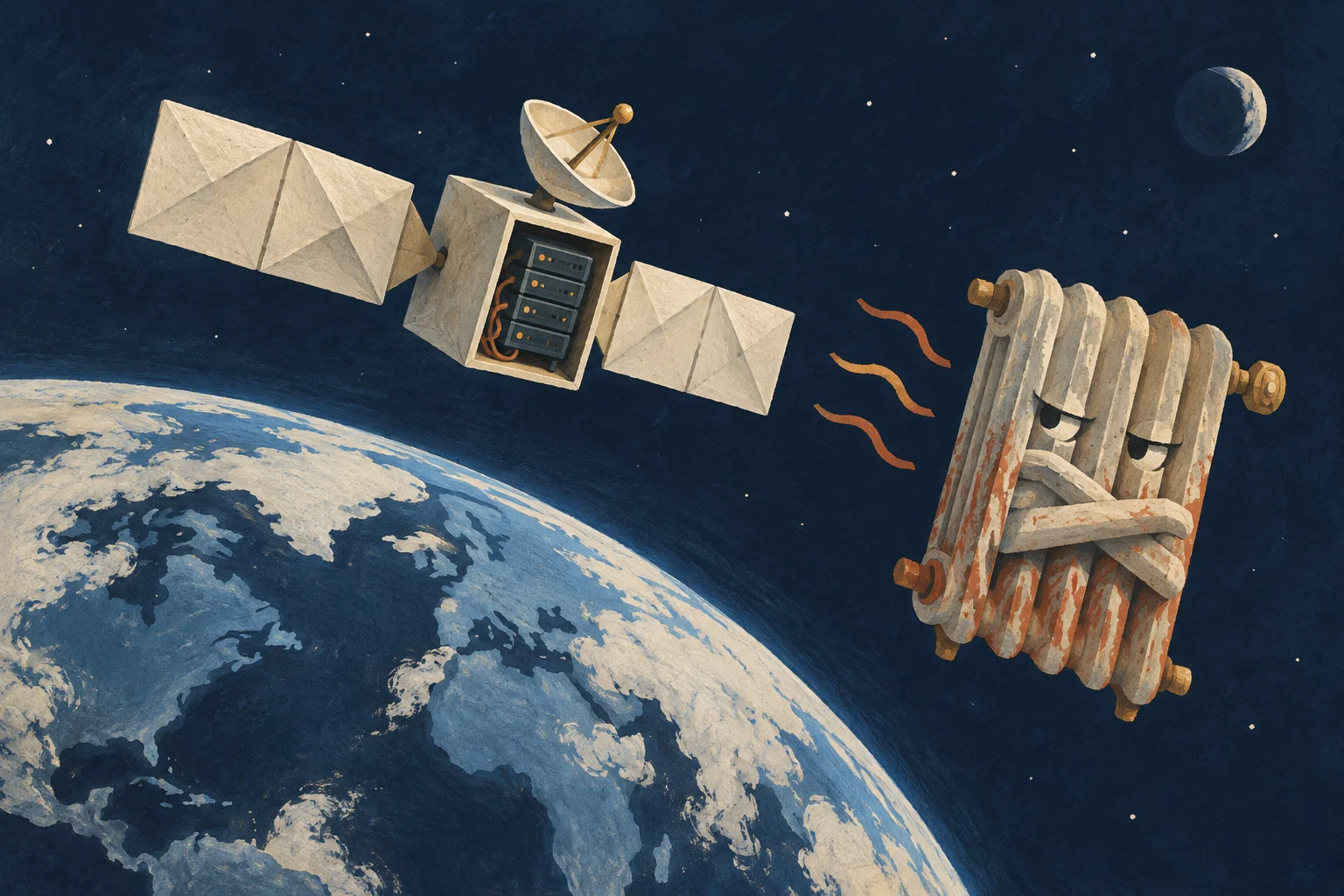
The terrestrial data center has encountered several regrettable stakeholders: the electricity grid, the water supply, the local planning process, and people who already live nearby. Naturally, the next logical step is to leave the planet.
Starcloud’s March announcement, subsequently corrected in April, described a $170 million Series A at a $1.1 billion valuation, led by Benchmark and EQT Ventures. The company presented its earlier orbital computing work and plans for further spacecraft as steps toward data centers in space. Those are company-reported milestones and plans, not an independent demonstration that an orbital facility can beat a terrestrial one on total cost.1
The coldest place without air conditioning
Space is cold in the way a place without air is cold. It does not provide a convenient breeze through your server room.
NASA’s thermal-control guidance explains that the vacuum environment lacks convection. Heat moves within spacecraft through conductive paths and must ultimately be managed through radiative exchange with the surroundings. Surfaces, orientation, absorbed sunlight, and heat rejection all matter.2
A picture of a satellite surrounded by cold darkness leaves the heat-transfer problem to someone else. Unfortunately, that person also has to get their equipment into orbit.
An excellent address for a very specific workload
Start with the workload. How much data must arrive, how quickly must an answer return, and what happens when a component needs attention? “Computing” covers jobs with very different tolerance for a long commute.
A workload generated by instruments already in orbit presents a different proposition from an interactive service used by people in offices. Moving less data down to Earth might be useful in one case. Transporting large volumes back and forth could dominate another. Latency requirements differ. So do tolerance for interruption and the useful life of the hardware.
These are questions to test, not conclusions about Starcloud’s particular designs. The company’s technical evidence should answer for its own system. A funding amount cannot do that job, even when expressed with a gratifying number of zeroes.
Imagine asking an ordinary data-center operator to quote a maintenance plan. Now imagine that the maintenance access is also an aerospace project. The comparison does not settle the economics, because launch costs and spacecraft designs can change. It does identify a line item that “unlimited solar energy” has not paid.
The spreadsheet should also make the trip
An attractive orbital-computing thesis needs assumptions that can be inspected. How much useful compute arrives per unit of launched mass? What fraction of time can it operate as intended? What are the communications requirements? How are failures handled? What happens when a chip remains functional but is no longer economically competitive?
A prototype earns its keep by resolving one of those uncertainties. It might demonstrate a component, test a thermal design, or expose a cost the spreadsheet treated too casually. None requires declaring the terrestrial data center obsolete.
The same discipline should apply to skeptics. Declaring that a concept will never work because the current version looks expensive is not analysis. Many useful systems began as absurdly expensive demonstrations. The relevant issue is whether there is a credible path from the demonstration to an economically useful service, and which steps on that path remain unproven.
What Earth is trying to tell us
There is a second story hidden in the appeal of leaving the planet. Infrastructure on Earth requires coordination with people who are not investors in the project. They have preferences about land, water, electricity, construction, and risk. Those preferences do not always arrive in the language of technological inevitability.
Some objections are ill-informed. Some processes are dysfunctional. Some constraints are real claims on shared resources. Sorting among them is less cinematic than commissioning a launch.
The view from the investment committee will be spectacular. Please attach the utility bill.