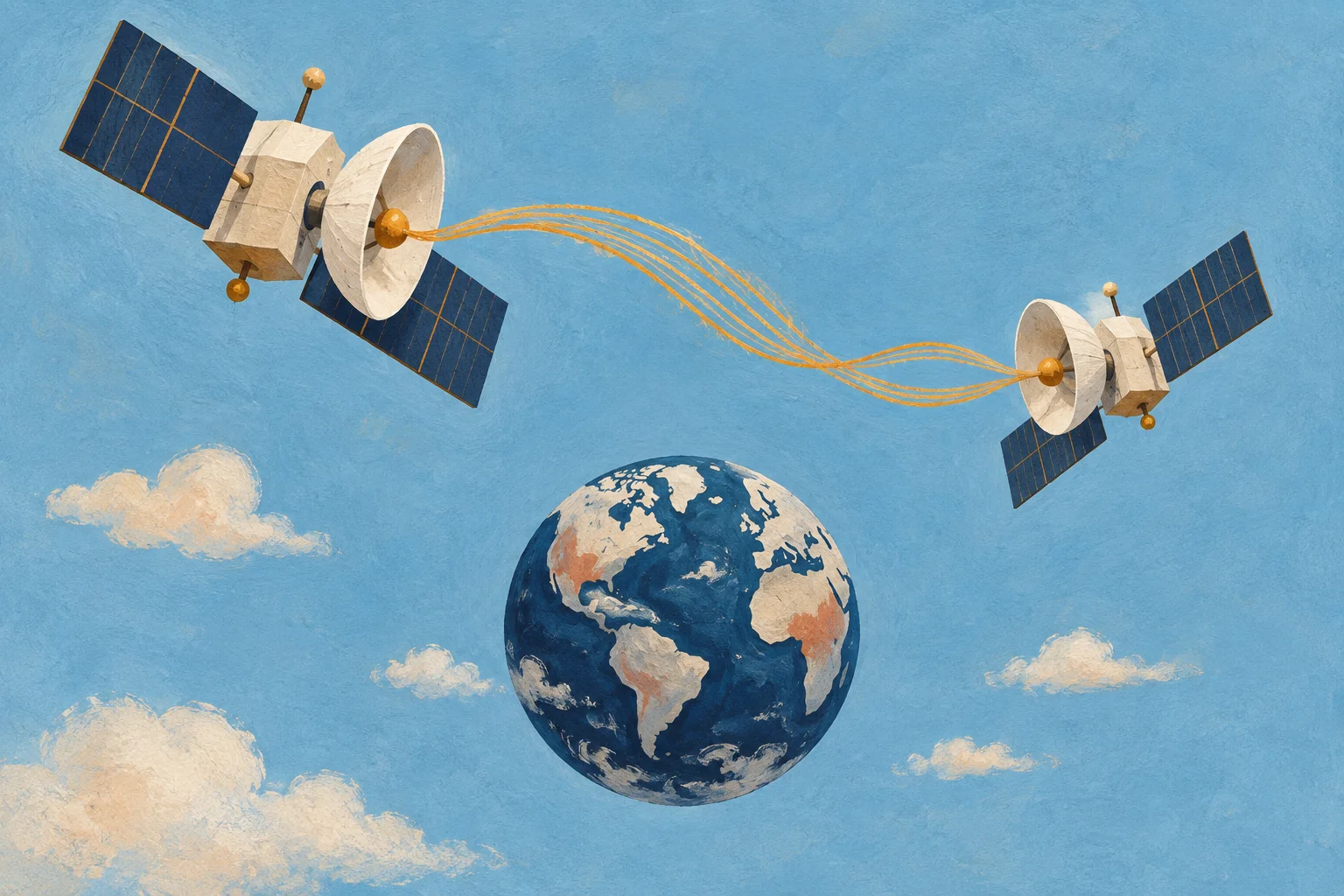
Satlyt raised $8 million to run AI on satellites.1 The cloud has developed a commendable interest in geographical accuracy.
The useful question is what work belongs there. A computer already near the data can have a different purpose from a computer placed far from its users because the location makes an excellent illustration.
Those proposals should get separate spreadsheets. They currently receive similar stars in the background.
Start with the inconvenient data
Consider an imaginary spacecraft generating sensor readings. Some readings require attention; many do not. A system that can identify the useful material before transmitting it could change the amount of information that needs to travel.
Whether that is worthwhile depends on the actual workload. What can be processed reliably onboard? How much communication does it save? What happens when an uncertain case needs a person on the ground? The demonstration should answer a question specific enough to disappoint the people who wanted an announcement about replacing Earth.
This hypothetical is not a performance claim about Satlyt. It is a way to ask where the commercial proposition begins.
Now consider a different fictional service: an orbital computer processing requests from terrestrial customers. Its data must make a different journey. The response time matters differently. The customer may have alternatives much closer to the office.
Calling both arrangements computing in space tells us where the equipment is. It does not tell us which customer benefits.
The maintenance team has a difficult commute
Spacecraft still have engineering constraints. NASA's guidance describes thermal control in an environment without convection.2 Cold surroundings do not give a machine an ordinary flow of cooling air.
A credible design deals with those constraints. It might do so impressively. The audience should examine the design without assuming that a dark backdrop has already solved the heat problem.
An experiment can establish a capability before the service is ready for a customer to depend on it repeatedly. Our imaginary onboard processor might be valuable at modest scale before anyone can justify a grander orbital platform.
Finding that bounded application would be progress. It need not apologize for failing to contain the entire future.
Infrastructure has several possible customers
The startup choosing its first application has a strategic decision. Does it sell a useful function into existing operations, or ask customers to adopt an entirely new arrangement? The second can offer a larger ambition. It can also require many more things to go right at once.
A narrow service can establish evidence about use, pricing, and reliability. That evidence can improve the next decision even if the eventual platform becomes much larger.
The investor is allowed to imagine the larger platform. The founder should still know which invoice comes first.
In our fictional pitch meeting, somebody asks how many customers need the service today. The slide advances to a photograph of Earth. It is a beautiful photograph and an unusually broad interpretation of the addressable market.
Give the founder credit for attempting the difficult engineering. Give the first useful application room to be smaller than the category.
The strongest orbital business might begin by sending less data down. Its pitch should begin by bringing the customer back into view.