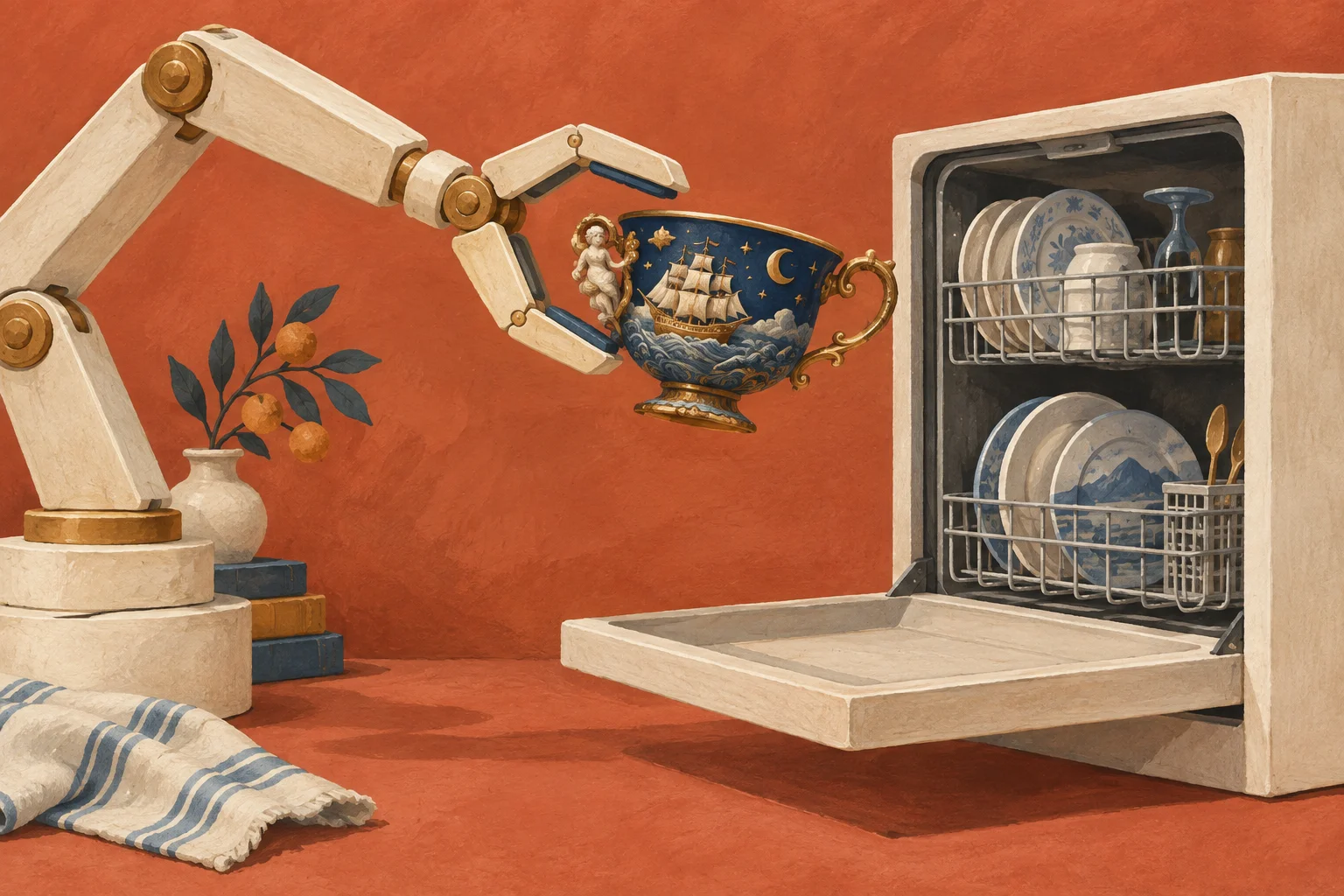
The general-purpose robot arrives with an impressive account of its capabilities. The dishwasher arrives with a saucepan in the wrong place. Negotiations begin.
Google DeepMind’s Gemini Robotics 2 announcement describes progress in whole-body control, dexterous manipulation, reasoning, and coordination across robotic systems. It also publishes uneven results across tasks and acknowledges remaining challenges, including multifinger dexterity and movement speed. These are company-reported evaluations, not tests conducted by us.1
Our dishwasher is hypothetical, not a reported Gemini Robotics 2 test. It is an ordinary appliance with an unreasonable number of opportunities to disappoint its owner.
The task contains more than the verb
“Load the dishwasher” sounds simple because humans compress shared context into the phrase. We know which objects are dirty, which are fragile, which should not go inside, and which arrangement is likely to leave the dishes clean.
Often we disagree. A substantial fraction of domestic life consists of people discovering that they did not share as much context as the instruction implied.
For a robot, the physical action is only part of the task. It must identify objects, understand their properties, plan movements, avoid collisions, and respond when the environment differs from expectation. It may need to recognize that it does not know whether a particular item belongs in the machine.
A success rate has a setting
The environment matters: the objects, the lighting, the available space, the initial arrangement, and the definition of completion. So does the cost of a mistake.
A robot that occasionally needs help may still be useful. The relevant question is how often, under what conditions, and how demanding the intervention becomes. A system that saves time overall can tolerate some imperfection. A system that requires continuous attention may have moved the work rather than removed it.
The human is not an infinite recovery mechanism
Many early systems rely on people to handle the cases they cannot. That can be a sensible design choice. It becomes misleading when the human support disappears from the account of the system’s autonomy.
In the hypothetical kitchen, someone might need to free a trapped object, identify an unfamiliar utensil, or decide whether a damaged cup should be kept. Each intervention may be minor. Their frequency and timing determine whether the overall experience is helpful.
An early request for help can save the cup. The household may prefer that to a confident attempt followed by a detailed account of the fragments.
Generality is a direction, not a household warranty
That does not mean all tasks become equally easy at once. Progress can be broad and uneven. A system may perform an impressive manipulation while struggling with something humans consider mundane.
The household acceptance test
For the eventual customer, the test is practical. Does the machine help enough to justify its cost, space, supervision, and maintenance? Does it behave predictably around people? Can someone understand what it is doing and stop it when needed?
Before teaching the robot everything, somebody will have to explain the good cups.