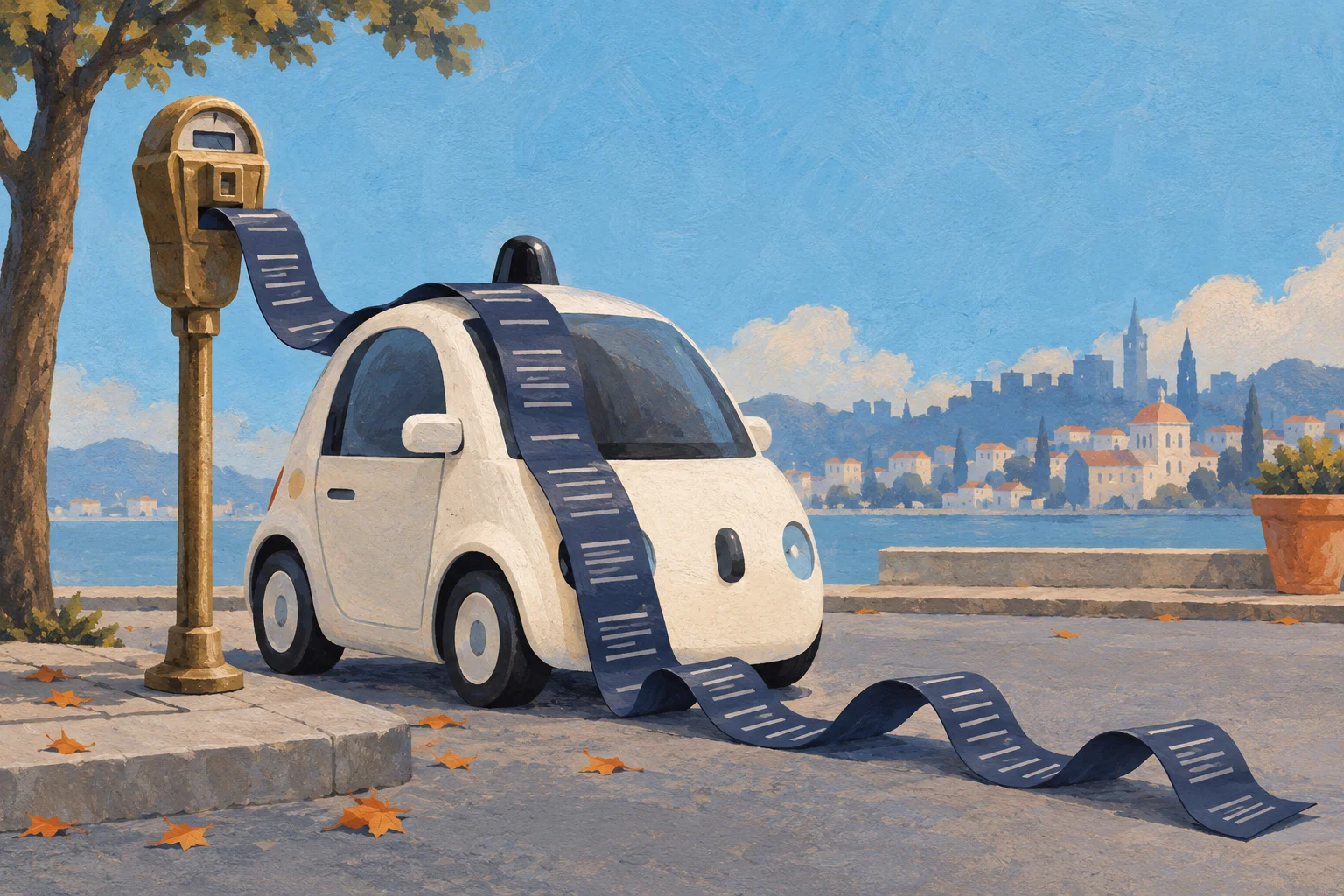
The autonomous vehicle has entered an advanced stage of urban integration: it is receiving parking tickets.
Gazetteer reported that SFMTA records showed 4,178 citations for Waymo vehicles in 2025 and another 4,131 through July 19, 2026—a combined 8,309. Its account included a response from Waymo saying it pays citations and continues working to improve operations with local agencies. These are figures reported by Gazetteer, not records independently analyzed by us.1
The total is notable. It is not a safety rate, a comparison with human drivers, or proof that every cited incident was equally serious. Without the appropriate exposure and context, a raw count cannot answer those questions.
The curb is a negotiated institution
A curb looks like a simple physical boundary. In a city, it is also a set of competing uses: passenger pickup, delivery, transit, accessibility, emergency access, parking, and the ability of other people to move past.
The rules can vary by place and time. The practical situation can be messy even when the rule is clear. A vehicle may need to choose among imperfect options because the convenient space is already occupied.
Human drivers also make a mess of the curb. A useful comparison needs comparable exposure and violations, rather than a contest between two groups pointing at each other’s bad parking.
The city is not a driving benchmark
These activities affect people who did not request the ride. A blocked lane matters to someone trying to use it. A poorly placed stop can complicate another person’s work. The passenger’s successful arrival does not capture every consequence.
Count those effects as part of operating the service. The street continues to have users who have not downloaded the app.
A ticket is information, not the entire answer
A count may change because of fleet size, activity, enforcement, classification, or behavior. Different violations may have different effects. A serious analysis would examine those distinctions before turning the total into a sweeping claim.
The useful next questions concern patterns. Where do problems repeat? Which situations create conflict? What changes reduce them? Can the operator and the city demonstrate improvement in a way that residents can understand?
The familiar problem of external costs
A fine creates a price for a violation. It does not necessarily reverse the inconvenience that occurred or establish that the price fully reflects it.
That is a general feature of enforcement, not a claim about Waymo’s internal calculations. An organization can pay its obligations while a city still needs to improve the underlying behavior.
Settling the fine does not give the delayed bus its time back. The city still has a reason to ask whether the behavior changes.
Read the municipal record
The future has learned to drive. The loading zone remains a continuing education requirement.